

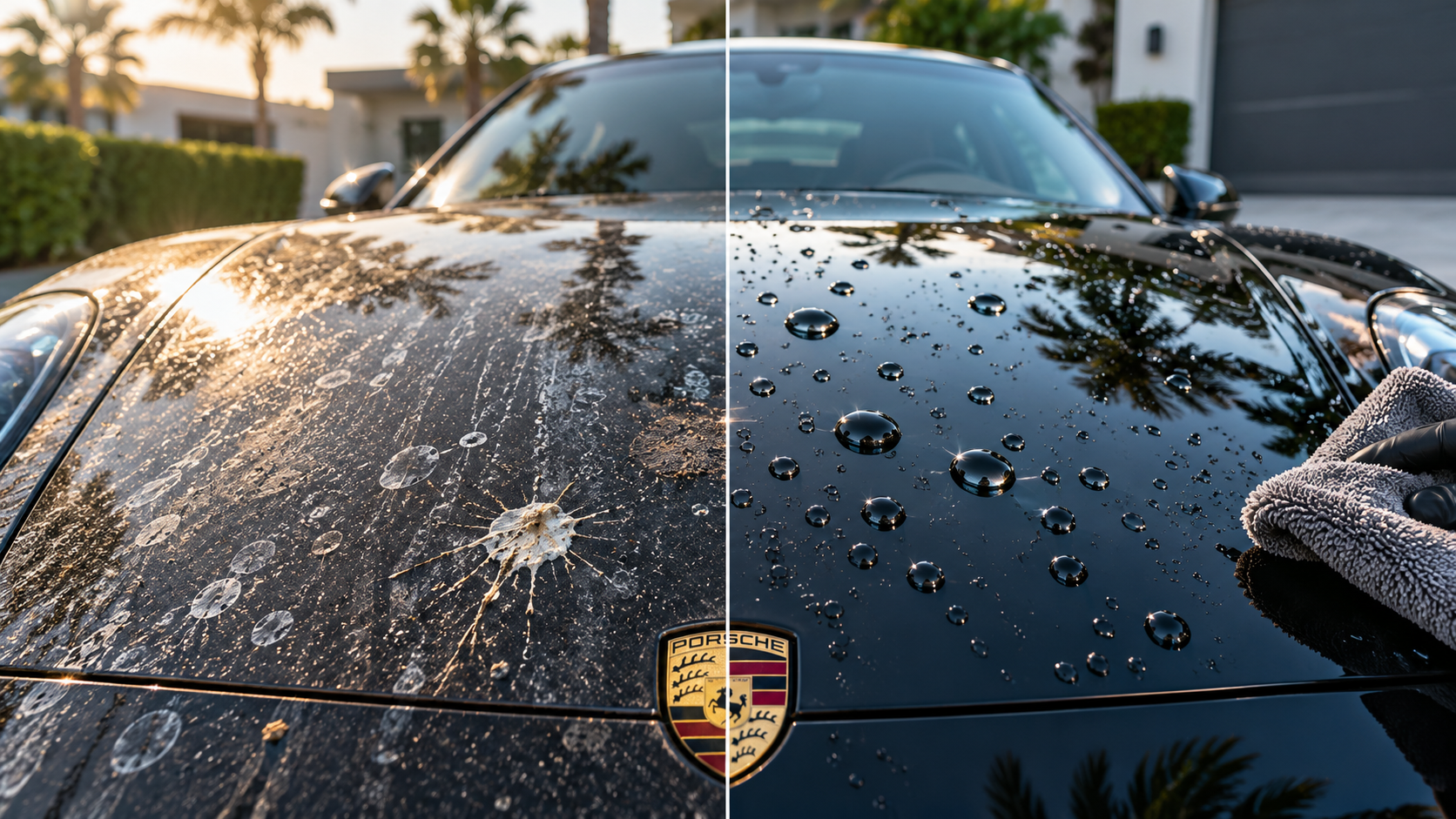
Ceramic coating mainly helps keep a vehicle’s exterior easier to clean by making dirt and grime less likely to cling tightly to the treated surface. It also adds water repellency. It is not armor against rock chips, deep scratches or careless washing, and contaminants can still leave stains, mineral deposits or etching.
So, what does ceramic coating protect against? Think of it as a surface-care aid rather than a damage-prevention shield. Its most dependable everyday benefit is easier cleaning; resistance to particular chemicals or environmental exposure depends on the actual product.
For Naples and Southwest Florida owners, that distinction matters. A car parked outdoors near trees or sprinklers has different care demands from one kept in a garage. Coating can make maintenance more manageable, but it does not cancel those exposures.
What can ceramic coating help with—and what can still cause damage?
Here is a practical overview before looking at individual concerns:
| Concern | Realistic expectation |
|---|---|
| Road grime and ordinary dirt | Easier washing, not a permanently clean vehicle |
| Bugs, bird droppings and sap | Cleanup can be easier, but timely removal remains necessary |
| Rain and sprinkler water | Water repellency, not immunity to deposits or water spots |
| Sun and oxidation | No universal level of protection follows from the words “ceramic coating” |
| Coastal residue | Continue washing it away; do not treat coating as rust protection |
| Swirls and scratches | Careful washing still matters; coating is not scratch-proof |
| Rock chips | Coating is not a substitute for impact-oriented protection such as paint protection film |
Gtechniq’s coating-maintenance guidance supports the easier-cleaning benefit while also emphasizing regular washing, drying and prompt contaminant removal. Those benefits and responsibilities belong together.
Does ceramic coating protect against bugs, bird droppings and tree sap?
The useful distinction is easier removal versus prevention of damage. A residue that washes away more readily is still something you should remove, not leave on the finish to test its protection.
Road grime and bug residue
Coating can make ordinary dirt and road film easier to wash away. That does not mean everything will rinse off without contact washing.
Bug residue deserves attention after a drive rather than waiting for a distant detailing appointment. As residue dries and hardens, removal becomes more difficult. Soften it with a suitable automotive cleaning product used according to its directions, then clean gently with clean wash media. Do not scrape it away or attack it with a rough sponge.
Bird droppings and sap
Remove bird droppings and sap promptly, even on a coated car. They can still damage a coated surface when left in place. There is no useful universal “safe number of hours” that applies to every contaminant, coating and exposure condition.
Do not dry-wipe droppings or force hardened sap off with repeated rubbing. Use a coating-compatible automotive product and allow it to soften the residue as directed. If gentle cleaning does not release it, exterior detailing is a better next step than increasingly aggressive scrubbing.
After removal, a remaining mark is not necessarily leftover dirt. It could be a deposit, staining or etching—damage to the surface itself. Those problems need different treatment, and more rubbing is not a reliable way to distinguish them.
Why can a ceramic-coated car still get water spots?
Water repellency describes how water behaves on the surface. It does not remove minerals from the water.
When mineral-containing droplets evaporate, deposits can remain. That is why sprinkler overspray and wash water still matter, even when the hood displays impressive beads. Rain exposure also does not leave a coated car automatically clean or spot-free.
Gtechniq’s paint-care guidance identifies mineral deposits and sprinkler exposure as water-spot concerns. Some marks are deposits on the surface; others involve etching. A visible spot alone does not tell you which one you have.
Three habits help:
- Park outside sprinkler spray patterns when possible.
- Wash and dry the vehicle after mineral-water exposure rather than repeatedly letting it evaporate.
- Address persistent spots with treatment appropriate to the coating, not household acids or abrasive polish chosen by guesswork.
If spots remain after a gentle wash, an assessment can help distinguish deposits from damage before choosing chemical treatment or correction.
What about Florida sun, oxidation and coastal exposure?
Do not buy a coating on the assumption that it makes paint sunproof. UV protection and oxidation resistance are performance questions about a particular product, not benefits that can be assigned equally to everything sold as ceramic coating.
If sun protection is a major reason for buying, look for documentation for the proposed product that addresses that benefit specifically. Water beading, gloss and an advertised service life do not establish UV performance. Covered parking remains a useful way to reduce direct exposure, whether or not the car is coated.
Coastal exposure calls for a similarly practical approach. If your parking location or driving leaves coastal residue on the vehicle, keep washing it away. Easier cleaning is useful here, but an exterior paint coating should not be treated as corrosion protection for exposed metal, the underbody or the vehicle’s structure.
Existing deterioration also needs its own diagnosis. A dull finish could involve contamination, surface defects or deteriorated paint. Coating does not reverse oxidation or repair failed clear coat. Peeling or missing clear coat requires refinishing rather than a promise of restoration through coating or polishing.
Will ceramic coating stop scratches, swirls or rock chips?
Do not rely on ceramic coating to prevent deep scratches or stone chips. Gtechniq explicitly distinguishes these limits in its overview of ceramic-coating benefits.
Wash-induced marks are another important limit. Dirty towels, abrasive brushes and wiping dust across dry paint can still mar a coated finish. A coating is not permission to use damaging washing methods.
Hardness claims do not change that decision. A hardness rating is not a real-world guarantee against keys, branches, road debris or wash swirls. Without the test method and conditions, the number alone is not a useful basis for choosing protection.
If front-end stone chips are your main concern, paint protection film, or PPF, is the more relevant category to investigate. Film serves a physical-protection role against chips and debris that ceramic coating does not. It still has limits, and its coverage determines which areas receive that protection.
Neither category should be treated as a guarantee against every impact, scratch or door ding.
Ceramic coating versus wax, sealant and paint protection film
Choose by the job you want the product to do—not by assuming every option sits on one universal protection ladder.
| Option | When it makes sense | Main tradeoff |
|---|---|---|
| Wax | You want a lower-commitment surface protectant and are comfortable renewing it | Reapplication remains part of the care routine; it is not chip protection |
| Paint sealant | You prefer a renewable surface-protection approach rather than committing to a coating installation | Performance and renewal requirements depend on the product; it is not an impact barrier |
| Ceramic coating | Easier routine cleaning and water repellency are priorities, and you will maintain the finish | Preparation, application and aftercare matter; washing and contaminant removal continue |
| Paint protection film | Stone chips and road-debris impacts are a leading concern | Coverage and film specifications matter; film does not prevent all damage or eliminate care |
Wax and sealant remain reasonable choices when you prefer a simpler, renewable care approach. Ceramic coating makes more sense when you value its surface behavior enough to commit to suitable preparation and ongoing maintenance.
Avoid choosing solely on a promised number of years. There is no single lifespan that accurately describes every wax, sealant, coating or film across different products, parking conditions and washing habits.
What affects the finished result?
The selected product matters, but so does the surface underneath it. Cleaning, correction and protection are separate tasks:
- Cleaning and decontamination remove dirt and attached residue.
- Paint correction addresses suitable defects such as swirls and some surface haze or etching.
- Ceramic coating adds protection to the prepared surface; it does not remove existing defects.
- Refinishing addresses paint loss or failure that detailing cannot repair.
Polishing reduces eligible defects by removing or leveling a small amount of the finish. That is why correction must match the defect and the paint’s condition rather than pursuing every scratch at any cost. Not every vehicle needs polishing before coating, and a new car should be inspected rather than automatically assigned aggressive correction.
Application quality also affects appearance. Uneven application can leave streaking or visible patches. Preparation, environmental conditions, curing and first-wash restrictions must follow the selected coating’s instructions; there is no universal waiting period suitable for every product.
Before scheduling, understand what preparation is included and what aftercare the actual coating requires. That is more useful than comparing vague “premium protection” labels.
What care does a coated car still need?
You do not need a complicated routine, but you do need consistent, gentle care:
- Wash according to exposure. Do not let visible grime accumulate indefinitely or wait for a fixed appointment to remove droppings and bugs.
- Rinse loose dirt before contact washing. Use clean wash media and an automotive shampoo compatible with the coating.
- Avoid dry-wiping and abrasive brush washes. Coated paint can still develop swirls.
- Dry after washing. Clean microfiber drying towels help avoid leaving wash water to evaporate.
- Follow product-specific aftercare. Do not add random boosters, strong cleaners or abrasive polish without checking compatibility.
Reduced beading does not automatically mean the coating is gone. Surface contamination can interfere with water behavior. Start with a proper wash; if the finish remains rough or behaves differently, have contamination assessed before using aggressive chemicals or polishing it.
Is ceramic coating right for your car?
Coating is a good match when you want easier washing, value the vehicle’s appearance and plan to keep maintaining it. Outdoor parking does not make coating pointless—it makes realistic cleanup habits especially important.
Choose a different priority if your main goal is stopping highway chips, repairing peeling paint or eliminating washing. PPF addresses a different physical-protection need; refinishing addresses paint failure; no surface protectant replaces cleaning.
For help with preparation, application or ongoing care, explore WOW Detailing’s services, including paint correction, ceramic coating and maintenance detailing. WOW is a mobile business serving Naples and Southwest Florida, so professional care can also be a convenience choice—not just a response to a problem.
The takeaway: buy ceramic coating for easier surface care, not immunity to damage. Match the product to your priorities and keep removing the things that can harm the finish.
Considering ceramic coating in Naples or Southwest Florida? WOW requires a suitable indoor garage at your location for application. Request a quote with your vehicle model, location and current photos to discuss your vehicle and setup.
Want professional help with your car?
Send us your vehicle make, model and a few current photos. We’ll recommend the right service based on the car’s actual condition.
Request a Quote