

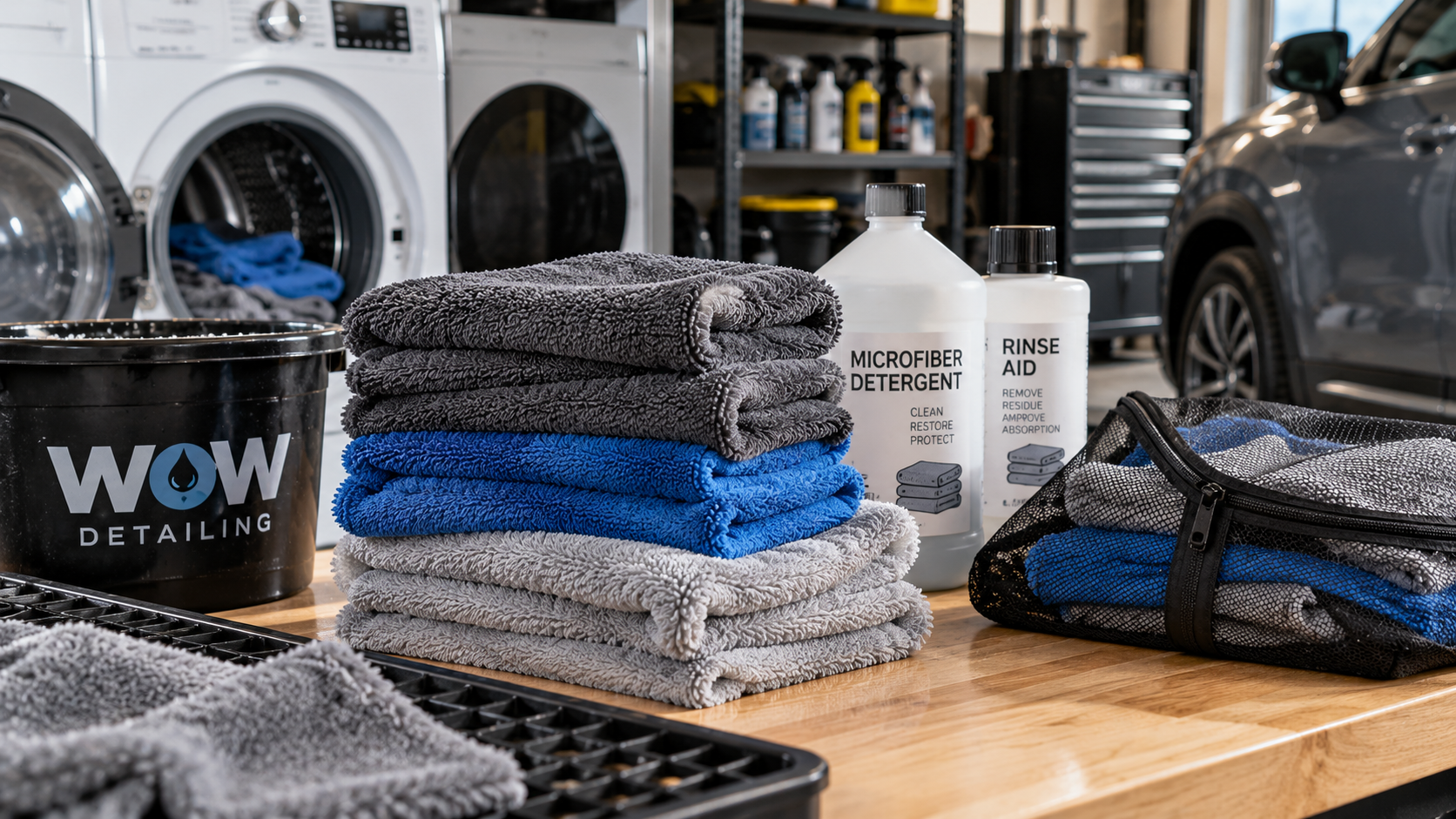
To wash microfiber car towels, separate them by task, wash them apart from other laundry with a compatible detergent and no fabric softener, then air-dry or tumble-dry according to their care instructions. Before using them again, check for trapped grit, stiffness and lingering residue. Store only completely dry towels in clean, covered containers.
The important distinction is removing washable residue versus removing embedded debris. Wax, polish or detergent residue can justify another cleaning attempt. A hard particle trapped in the towel is a different problem: washing does not guarantee its removal, and a clean-looking towel is not automatically ready for paint.
Here is a practical routine, from the used-towel pile to the next wash day.
Start with the towel and product instructions
Check the towel’s care label or its manufacturer’s care instructions before choosing a wash temperature or dryer setting. Also check the instructions for the detailing products used with it, particularly coatings and strong chemicals.
Cold or warm washing and low-heat tumble-drying are common recommendations in detailing-care guidance, but they are not universal specifications. Use the permitted temperature and cycle for your towels rather than assuming the hottest setting will clean them best.
Keep these instructions accessible, especially if you own several towel types. A drying towel, glass cloth and coating-removal towel should not automatically receive identical treatment.
For ordinary detailing towels, wash after use rather than folding them back into the clean supply. If a towel falls on the driveway or garage floor, take it out of service for inspection and washing instead of giving it a quick shake and returning to the paint.
Sort towels by job and contamination
Sort before loading the washer. The goal is to keep grit and heavy product residue away from towels used on delicate surfaces.
| Towel group | Practical sorting approach |
|---|---|
| Paint and drying towels | Keep separate from wheel, tire and greasy utility towels. Isolate heavily soiled examples. |
| Glass towels | Keep their own group to limit transfer of oily dressings, wax and polish residue. |
| Interior towels | Separate lightly used cleaning towels from towels loaded with dressing or heavy soil. |
| Polish, wax and sealant towels | Group by residue level; do not mix heavily loaded towels with lightly used drying towels. |
| Wheel, tire and utility towels | Wash separately from paint towels, with especially greasy or chemically contaminated towels held aside. |
| Coating applicators and removal towels | Keep out of the ordinary wash routine until the coating’s instructions establish what to do. |
You do not need to run a separate machine cycle for every individual towel. Build compatible batches without combining the dirtiest work with your cleanest tasks. Labeled containers or color coding make this easier, but color identifies a towel’s assignment—not its cleanliness.
Wash microfiber apart from cotton bath towels, clothing and other lint-shedding fabrics. Microfiber collects lint, and adding household laundry creates another contamination source. Adam’s microfiber-care guidance supports separating fabrics and keeping the dirtiest towels in their own loads.
Inspect before the wash
Open each towel and look for grit, plant fragments, heavy buildup and stiff patches. Shake out loose debris away from the vehicle and clean-towel storage.
Keep towels with embedded particles or substantial grease out of the normal load. Do not assume the washer will make them suitable for paint again. Towels saturated with a chemical product also need that product’s handling instructions before they go into household laundry equipment.
For ordinary wax, polish or oily detailing residue, a permitted pretreatment or soak can help loosen buildup. Use the detergent’s directions for concentration and duration rather than improvising a stronger mixture or an extended soak.
Choose a detergent that cleans without adding softener
A dedicated microfiber detergent is one option, not a requirement for every towel or every load. A compatible household liquid detergent can also be suitable.
| Option | When it is useful | What to check |
|---|---|---|
| Dedicated microfiber detergent | For regular detailing laundry, particularly towels carrying wax, polish or dressing residue | Compatibility, dosing and any specific pretreatment directions. Different products are not interchangeable. |
| Household liquid detergent | For routine laundry when the towel maker permits it | Choose a dye-free, fragrance-free option without fabric softener, and follow the label dose. |
Adam’s guidance accepts dye-free, perfume-free liquid laundry detergent, while also offering a dedicated product. There is no need to assume an ordinary compatible detergent damages microfiber or that a specialty detergent restores every towel.
Skip fabric softener, including detergent with built-in softener. Softening deposits can reduce the towel’s absorbency and cleaning effectiveness. The same principle applies to fabric-softening dryer sheets.
Do not add bleach unless the towel manufacturer explicitly permits it. Choose fragrance-free detergent as a straightforward way to avoid unnecessary additives—not because every fragrance has been shown to damage microfiber. Use a compatible laundry product rather than substituting dish soap or a homemade restoration mixture.
Measure detergent according to its label, accounting for the load and soil level. More detergent is not a substitute for sorting or pretreatment, and it gives the rinse cycle more to remove.
Wash with room to move and rinse
Once you have sorted and inspected the towels:
- Check the washer. Remove visible lint or debris, and make sure fabric softener will not be dispensed into the load.
- Load compatible microfiber towels together. Do not pack the drum tightly; towels need room to move through washing and rinsing.
- Add the measured detergent. Follow the product’s laundry directions, including machine compatibility.
- Select the towel-approved temperature and cycle. Warm water is commonly recommended for detailing residue when the towel instructions allow it.
- Use an additional rinse when useful. It is a reasonable option for residue-heavy loads or suspected detergent carryover, not a requirement for every wash.
Adam’s recommends an extra rinse to help remove remaining detergent and contamination. An extra rinse does not make a gritty towel safe or replace another wash when oily residue remains.
If towels repeatedly emerge oily, odorous or poorly rinsed, review the detergent dose, load size and sorting. Check the washer’s maintenance instructions for softener buildup, lint or other contamination before putting more paint towels through the same routine.
Avoid escalating to boiling or aggressive chemical mixtures. A persistent problem calls for reassessing the towel and its contamination, not simply increasing heat or chemical strength.
Dry completely without excessive heat or lint
Both protected air-drying and permitted low-heat tumble-drying are useful options. Choose according to the towel instructions and the drying space available.
Air-drying
Spread or hang towels on a clean rack with space between them. Use a location protected from dust, yard debris and lint. Draping a clean towel over a dusty garage surface defeats the wash.
Air-drying avoids dryer heat, but it requires enough time and airflow. In a humid Naples or Southwest Florida garage, confirm that towels are dry throughout instead of assuming an overnight stay on the rack was enough.
Tumble-drying
Use the setting allowed by the towel maker; low heat is commonly recommended. Clear the lint filter, check the drum for debris and keep microfiber separate from lint-producing fabrics. Leave out dryer sheets and do not overfill the dryer.
High dryer heat can stiffen or damage microfiber. Lithium’s towel-care guidance recommends low-heat drying or air-drying.
Whichever method you choose, check thicker areas, folds and edges before storage. If they are still damp, continue drying rather than closing the towel inside a bin.
Inspect before reuse: rewash, downgrade or retire?
Unfold each clean, dry towel under good light. Check both faces and the edges for:
- Embedded particles or debris caught deep in the pile.
- Hard, rough or stiff areas.
- Oily feel, lingering residue or persistent odor.
- Matted or visibly damaged fibers and edges.
- Reduced water pickup compared with its normal performance.
For a questionable drying towel, a small clean-water check can reveal poor absorbency. It is a performance check, not a scratch-safety test. Neither appearance, touch nor water pickup guarantees that every abrasive particle is gone.
Use condition—not age or a promised number of washes—to decide what happens next.
| What you find | What to do |
|---|---|
| Apparent detergent, wax, polish or dressing residue, with otherwise intact fibers | Rewash separately using a permitted pretreatment if appropriate. Reassess after drying. |
| An otherwise clean, intact towel that no longer meets your standard for paint or glass | Assign it to a genuinely lower-risk task and label it clearly. |
| Embedded grit, persistent hard patches, roughness or damaged fibers | Retire it from vehicle-surface use. Do not assume a different panel makes the contamination acceptable. |
| Persistent chemical contamination or unknown heavy chemical exposure | Stop reuse and follow the product’s handling and disposal guidance. |
A stain by itself does not prove a towel is abrasive, just as a spotless appearance does not prove it is suitable for paint. Focus on the contamination history, physical condition and performance together.
Downgrading also needs judgment. Painted wheels, gloss-black interior trim and screens are not forgiving destinations for a gritty towel. A clean, intact towel might be useful for a nonsensitive utility task; a towel with retained abrasive debris should not simply move from one finished vehicle surface to another.
Handle ceramic-coating towels separately
Do not automatically apply the ordinary laundry routine to coating applicators or towels used to level and remove a ceramic coating. Different coating products have different handling requirements, and washing is not proof that a used application towel is ready for paint again.
Check the specific coating’s current instructions and safety data sheet for:
- Whether towel laundering or reuse is allowed.
- Any handling precautions before laundering or disposal.
- Disposal instructions and applicable local requirements.
If those documents do not clearly address towels and applicators, contact the coating manufacturer before washing them. For products with hazardous or regulated ingredients, ask the local solid-waste authority how its disposal rules apply.
Do not assume that all coating towels must follow one disposal method, that they are safe in household laundry, or that they can automatically become shop rags. Also, use the actual product instructions rather than making a decision solely because a spray product has “ceramic” in its name.
Store towels clean, dry and separated by task
Fold fully dry towels on a clean surface and place them in clean, covered containers or bags. Keep paint, glass, interior and utility groups clearly separated, with retired towels removed from the paint supply.
Malco’s microfiber-care guidance warns against damp storage because of mold and mildew. A lid protects against garage dust; it does not make a damp towel ready to store.
Before the next detail, give each towel another quick check as you unfold it. That catches debris picked up during handling or storage.
Your wash-to-storage checklist
- Check towel and detailing-product instructions.
- Sort by task and contamination; keep microfiber away from lint-shedding laundry.
- Inspect and isolate grit, heavy residue and chemical contamination.
- Wash with compatible detergent, no softener and room for movement.
- Use permitted pretreatment or an extra rinse when needed.
- Air-dry or tumble-dry according to the label, then confirm complete dryness.
- Inspect; rewash, downgrade or retire according to condition.
- Store covered and separated by task.
The goal is not to save every towel. It is to keep a dependable supply of clean, suitable towels—and prevent a questionable one from returning to a delicate surface.
Want professional help with your car?
Send us your vehicle make, model and a few current photos. We’ll recommend the right service based on the car’s actual condition.
Request a Quote