

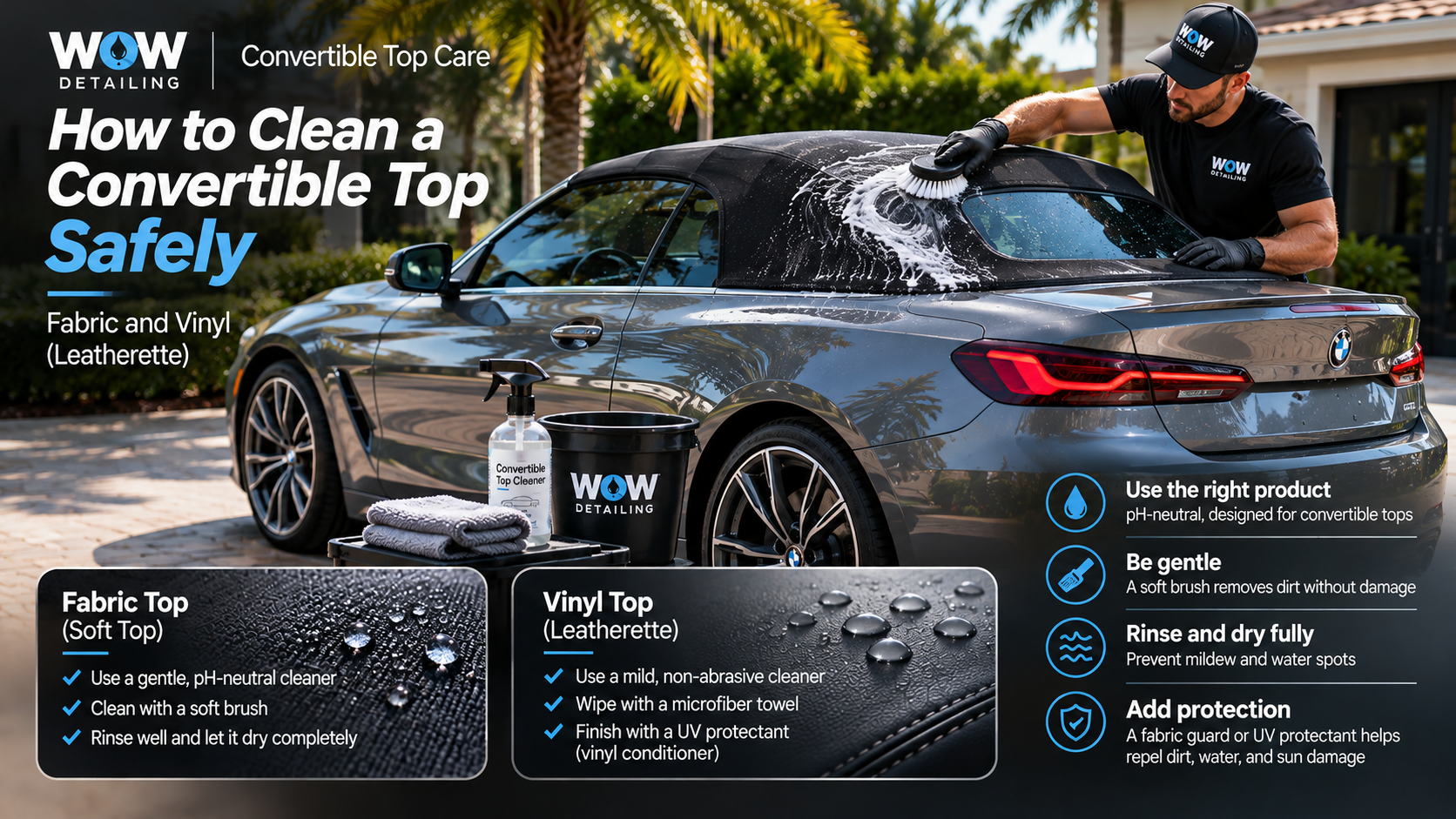
The safest way to clean a convertible top is to identify the roof material, use a compatible cleaner and gentle tools, rinse thoroughly, and let the roof dry completely before folding it. Fabric and vinyl need different product choices, and the rear window needs its own care routine.
For convertible owners in Naples and Southwest Florida, timing matters too. Work on a cool roof in shade so cleaner does not dry before you can rinse it. Choose a day when the top can remain raised long enough to dry—not immediately before rain or a planned top-down drive.
Identify your roof and rear window first
Check the owner’s manual to confirm whether the roof is fabric or vinyl. If the top has been replaced, use the replacement-top paperwork or contact its manufacturer or installer; the original vehicle manual may no longer describe the installed material.
Do not rely on appearance or a water-drop test alone. Water behavior does not reliably identify a roof or tell you which cleaner belongs on it.
Identify the rear window separately as glass or plastic. A cleaner suitable for the roof is not automatically suitable for the window, seals, or surrounding trim.
Here is the practical difference between the two main roof-care routines:
| Care decision | Fabric top | Vinyl top |
|---|---|---|
| Cleaner | Product explicitly compatible with the convertible’s fabric roof | Product explicitly compatible with convertible-roof vinyl |
| Agitation | Light brushing with an approved soft brush, when directed | Gentle wiping with an approved soft applicator; use a brush only if permitted |
| Main cleaning focus | Remove soil without forceful scrubbing, and rinse cleaner out thoroughly | Clean the textured surface without abrasive tools or aggressive scrubbing |
| Aftercare | Fabric treatment only when recommended for that roof | Vinyl treatment only when recommended for that roof |
An “automotive” or “pH-neutral” label alone does not establish roof compatibility. Match the product’s intended surfaces to your roof’s care instructions.
Gather supplies and prepare the car
For an ordinary maintenance wash, gather:
- A cleaner compatible with the roof material.
- The soft brush, cloth, or applicator approved for that cleaning method.
- Clean rinse water and a garden hose with gentle, controllable flow.
- Separate window-care products and clean tools appropriate for the rear window.
- Any protective materials the cleaner’s label requires for adjacent surfaces.
Read the instructions before starting. Check dilution, wet-versus-dry application, dwell time, agitation, rinsing, and spot-testing directions. Do not borrow a dilution or waiting time from a different cleaner. Where a spot test is directed, use an inconspicuous area; a successful test does not override a compatibility restriction.
Raise and secure the roof fully, close the windows, and inspect the material, seams, and rear-window edges. If you find tears, loose stitching, flaking material, or a known leak, pause the wash and arrange an assessment rather than soaking or brushing the damaged area.
Finally, feel the roof. Shade is not enough if the surface is still hot from parking in direct sun. Let it cool before applying cleaner.
How to clean a fabric convertible top
1. Remove loose debris gently
Clear leaves and loose contamination before working cleaner into the roof. Use the debris-removal method specified for the material. Depending on the instructions, that can involve gentle dry removal or an initial rinse; neither sequence is universal.
Do not grind grit into the fabric or drag a dirty tool across it. The goal is to remove loose material, not scrub the roof dry.
2. Apply the compatible cleaner as directed
Wet the roof first only if the cleaning instructions call for it. Apply the specified amount of cleaner evenly and work methodically across the roof.
More product is not a shortcut to a cleaner top. Excess cleaner adds to the rinsing work, particularly on fabric. Keep the surface from drying while you work, and stay within the label’s dwell time.
For a generally dirty roof, clean the full surface evenly rather than heavily scrubbing one conspicuous patch. Hagerty’s convertible-top care guidance notes that isolated cleaning on an aged top can leave an area noticeably cleaner than its surroundings. That does not mean leaving fresh bird droppings in place; remove fresh contamination promptly using the approved method.
3. Agitate lightly where required
Use a roof-approved soft brush with light pressure when the instructions call for brushing. Pay attention to soiled areas without repeatedly attacking them.
If a mark is not responding to the prescribed cleaning, do not compensate with a stiffer brush, longer dwell time, or stronger chemical. Finish the approved cleaning and rinsing process, let the top dry, and reassess. A remaining mark is not necessarily removable dirt.
4. Rinse thoroughly
Rinse the entire cleaned area with gentle water flow, including places where cleaner has collected near seams and edges. Continue according to the product directions rather than stopping as soon as the obvious foam disappears.
The shared essentials in Gtechniq’s convertible-top cleaning guide are gentle cleaning, avoiding premature cleaner drying, thorough rinsing, and complete drying before folding. Its product-specific treatment instructions should not be treated as universal roof-care requirements.
How to clean a vinyl convertible top
Start with the same preparation: identify the material, check the roof’s condition, cool the surface, and remove loose debris.
Apply a cleaner explicitly suitable for convertible-roof vinyl according to its directions. Use an approved soft cloth or applicator, working gently over the textured surface. If the applicable instructions permit a soft brush, use light pressure rather than trying to scour dirt out of the grain.
Keep the cleaner from drying and rinse thoroughly. Do not treat vinyl as a reason to use a stiff household brush or a stronger degreaser.
After drying, distinguish leftover contamination from deterioration. Cracking or flaking is a condition problem, not an invitation to scrub harder. A vinyl dressing is also not a cleaner or a repair for damaged material.
Handle seams, seals, and rear windows separately
Use controlled water flow around seams, seals, roof edges, and the rear-window perimeter. Do not aim a forceful stream into these areas to chase out dirt.
For a home wash, use a gentle hose rinse and skip the pressure washer unless your vehicle or roof manufacturer expressly permits it. There is no single nozzle angle, distance, or pressure setting that makes pressure washing appropriate for every roof and condition.
Keep roof brushes off the rear window and avoid transferring roof cleaner onto it unless compatibility is confirmed.
- Plastic rear window: Remove loose grit before wiping and use a cleaning method intended for that window. Do not assume ordinary glass cleaner or a roof-cleaning cloth is suitable.
- Glass rear window: Follow the vehicle’s window-care instructions, including any restrictions for tint, coatings, or heating elements. Glass does not make every cleaner or tool acceptable.
Use separate, clean window tools. If a plastic window is hazy, yellowed, or scratched, do not jump straight to polishing; the material and its condition need to be identified first.
Seal and folding-mechanism maintenance is another separate task. Use only the specified care products and lubrication procedure, keeping excess lubricant off the roof material.
Rinse away residue and let the roof dry completely
Residue prevention begins before rinsing: use the correct amount of cleaner, work on a cool surface, and prevent the product from drying during cleaning.
During the rinse, look for remaining suds and runoff carrying cleaner. Rinse those areas again. No visible foam is a useful sign, but it is not proof that all cleaner has left the fabric; complete the label’s rinsing procedure.
CarParts.com’s roof-cleaning guide identifies leftover cleaner as a cause of white streaks. If streaks appear after drying, do not immediately apply protectant or attack them with a stronger cleaner. Follow the original product’s residue-removal guidance and reassess before further treatment.
Leave the roof raised until it is fully dry. Folding a damp roof traps moisture and encourages mold or mildew. Fabric can retain moisture even when the exposed surface feels dry, so consider seams and folds as well as the broad panels.
There is no universal drying time. Humidity, shade, airflow, and rain affect the available drying window. In Southwest Florida, plan around actual conditions rather than assuming a quick wash will be followed by a quick dry.
What to avoid—and when to stop
Avoid improvising with bleach, household detergents, vinegar, alcohol, solvents, harsh degreasers, or general-purpose cleaners without explicit approval for your roof. These products are not interchangeable, and a household cleaning recipe is not a compatibility check.
Also avoid abrasive pads, stiff brushes, forceful water, and repeated scrubbing. Do not use paint compound or polish on fabric or vinyl roof material. Paint correction addresses suitable painted surfaces, not soft-top deterioration.
Use these stopping points to choose the next step:
| What you notice | What to do next |
|---|---|
| A stain remains after one careful, approved cleaning | Stop escalating the treatment; seek advice for the specific material and stain |
| Suspected mildew, recurring odor, or returning discoloration | Arrange an assessment rather than relying on stronger cleaner or a surface dressing |
| Tears, loose seams, failed stitching, cracked or flaking vinyl | Contact a convertible-top or automotive upholstery specialist |
| Water entering around the roof or window | Have the leak assessed; protectant is not a leak repair |
| Window separation, significant distortion, or mechanism trouble | Seek roof-system or window-repair expertise before further cleaning or operation |
Cleaning removes contamination. It does not repair damaged material, restore failed stitching, or resolve a roof that will not latch correctly.
Keep the top clean between washes
Remove leaves and other debris regularly, and address bird droppings or sap promptly using a roof-approved method. Do not substitute a solvent when sap resists routine cleaning.
Covered parking can reduce exposure to sun and contaminants. When parking under trees for shade, check for accumulated leaves, sap, and droppings. Avoid brush-style automatic washes unless the vehicle manufacturer approves them.
Treat protection as optional, material-specific aftercare. If a fabric protectant or vinyl treatment is recommended, apply it only to a clean, fully dry roof and follow its preparation and application instructions. Do not assume every roof needs treatment after every wash or that reduced water beading proves a leak.
Protective products do not replace cleaning or repair, and fabric and vinyl treatments are not interchangeable.
When mobile detailing can help
Routine professional detailing can be useful for ongoing vehicle care and convenience—not only after a difficult stain appears. Explore WOW Detailing’s mobile interior and exterior detailing services for your convertible in Naples and Southwest Florida. Ask WOW to confirm whether your particular roof material and cleaning needs fit its services before including roof care in the job.
The essential routine is straightforward: confirm the material, clean gently in shade, rinse completely, and keep the roof raised until dry. Persistent stains need a different decision—not automatically more scrubbing—and damaged roofs need repair expertise.
For help with routine vehicle care, request a detailing quote through WhatsApp. Share your vehicle model, location, roof material, and current photos so WOW can confirm service fit.
Want professional help with your car?
Send us your vehicle make, model and a few current photos. We’ll recommend the right service based on the car’s actual condition.
Request a Quote